
Choosing the right structure is one of the most critical decisions when launching a business in India. While traditional partnership firms carry unlimited personal liability and private limited companies come with heavy compliance requirements, the Limited Liability Partnership (LLP) offers an ideal middle ground.
Introduced under the Limited Liability Partnership Act, 2008, an LLP combines the operational flexibility of a traditional partnership with the legal protection of a corporate entity. For entrepreneurs, startups, and service professionals, deciding to Register LLP Company In India provides peace of mind through distinct legal status and limited personal liability.
This comprehensive guide breaks down the essential aspects, prerequisites, benefits, and step-by-step process of Online LLP Registration under the Ministry of Corporate Affairs (MCA).
What is a Limited Liability Partnership (LLP)?
A Limited Liability Partnership is an alternative corporate structure where the liability of each partner is limited to their agreed contribution to the business. Unlike traditional partnership firms, where partners are personally liable for business debts and the actions of co-partners, an LLP functions as a separate legal entity. It can own property, enter into contracts, and incur liabilities in its own name.
+—————————————+
| Limited Liability Partnership |
+—————————————+
/ \
/ \
+———————————+ +———————————-+
| Corporate Advantage | | Partnership Advantage |
| – Separate legal entity | | – Flexible internal operations |
| – Limited personal liability| | – Lower compliance burden |
| – Perpetual succession | | – No minimum capital floor |
+———————————+ +———————————-+
Core Characteristics & Essential Prerequisites
Before initiating the registration process, founders must meet specific structural requirements:
1. Key Structural Requirements
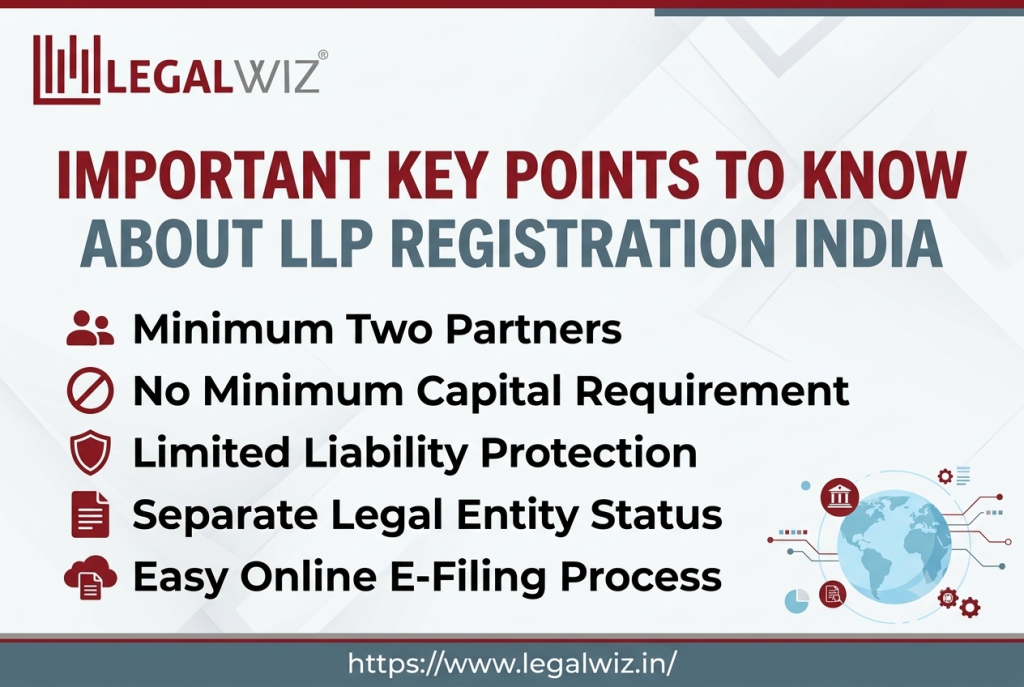
- Minimum Partners: An LLP requires at least 2 partners to incorporate. There is no upper limit on the maximum number of partners.
- Designated Partners: At least 2 natural persons must act as Designated Partners responsible for legal compliances. At least one designated partner must be an Indian resident (residing in India for at least 120 days in the previous calendar year).
- No Minimum Capital Mandate: Unlike traditional corporate structures, an LLP does not require a minimum paid-up capital. You can register an entity with as little as ₹1,000 as total capital.
- Registered Office: The LLP must maintain a registered address in India to receive official correspondence.
Primary Advantages of Registering an LLP
Why do startups and professional service firms favor the LLP structure?
| Feature | Limited Liability Partnership (LLP) | Private Limited Company | Traditional Partnership |
|---|---|---|---|
| Legal Entity | Separate Legal Entity | Separate Legal Entity | Not a Separate Entity |
| Partner Liability | Limited to Contribution | Limited to Shares Held | Unlimited |
| Minimum Capital | None | None | None |
| Audit Exemption | Exempt below ₹40L turnover or ₹25L capital | Mandatory from Day 1 | Not Mandatory |
| Compliance Load | Low | High | Very Low |
Key Benefits
- Protection of Personal Assets: Partners are not personally liable for the debts or liabilities of the LLP. Misdeeds or negligence of one partner do not bind others.
- Audit Exemptions: An LLP is exempt from mandatory annual financial audits unless its turnover exceeds ₹40 Lakhs or its capital contribution exceeds ₹25 Lakhs.
- Operational Flexibility: Internal governance is determined entirely by the LLP Agreement, allowing partners to structure profit-sharing, voting rights, and management duties as they see fit.
Required Documentation Checklist
To ensure a smooth process to Register LLP Company In India, keep the following documents ready:
Important Note: All self-attested identification and address proofs for Indian partners must reflect matching details. Foreign nationals must have their documents notarized or apostilled in their home country.
+———————————————————————————–+————————
| DOCUMENTATION CHECKLIST |
+—————————————————–+—————————–+———————-
| FOR PARTNERS & DESIGNATED PARTNERS | FOR REGISTERED OFFICE |
+—————————————————–+—————————–+———————–
| • PAN Card (Mandatory for Indian Nationals) | Proof of Ownership/Lease |
| • Identity Proof (Aadhaar, Passport, or Voter ID) | Recent Utility Bill |
| • Address Proof (Bank Statement or Utility Bill) | (Electricity/Water/Gas) |
| • Passport-size Photograph | No Objection Certificate |
| • Class 3 Digital Signature Certificate (DSC) | (NOC) from Property Owner |
+—————————————————–+—————————–+————————
Step-by-Step Online LLP Registration Process
The Ministry of Corporate Affairs (MCA) has streamlined the Online LLP Registration workflow through its V3 portal, making it largely paperless.
1. Obtain Digital Signature Certificates (DSC): Step 1.
Because all filings on the MCA portal are electronic, all designated partners must acquire a valid Class 3 Digital Signature Certificate (DSC) to sign incorporation forms.
2. Reserve the LLP Name via RUN-LLP: Step 2.
Submit up to two proposed names using the RUN-LLP (Reserve Unique Name – Limited Liability Partnership) service. The name must be unique, non-infringing on trademarks, and strictly end with “LLP” or “Limited Liability Partnership.”
3. File the FiLLiP Incorporation Form: Step 3.
Fill out the FiLLiP (Form for Incorporation of Limited Liability Partnership). This comprehensive form handles:
- Allotment of Designated Partner Identification Numbers (DPIN/DIN) for up to 2 partners
- Registered office address details
- Partner details and capital contributions
- Automatic PAN and TAN application for the LLP
4. Receive Certificate of Incorporation (CoI): Step 4.
Once the Registrar of Companies (RoC) verifies and approves Form FiLLiP, a Certificate of Incorporation containing the unique LLPIN (LLP Identification Number) is issued.
5. Draft & File Form 3 (LLP Agreement): Step 5.
Within 30 days of incorporation, the partners must execute an LLP Agreement on requisite state-wise stamp paper and file Form 3 on the MCA portal. Failing to meet this deadline attracts daily monetary penalties.
Mandatory Annual Compliance Post-Incorporation
Registering the entity is just the beginning; maintaining its active status requires meeting recurring compliances:
- Filing Annual Return (Form 11): Contains partner details and capital summary. Due annually by May 30th.
- Statement of Accounts & Solvency (Form 8): Details the financial condition of the LLP. Due annually by October 30th.
- Income Tax Return (ITR-5): Annual tax filing due by July 31st (or October 31st if audit applies).
- DIR-3 KYC: Annual KYC verification for all Designated Partners holding a DPIN.
Conclusion
Opting for an Online LLP Registration gives entrepreneurs the best of both worlds: robust corporate standing with limited liability, alongside an agile management system with minimal compliance friction. By ensuring key requirements are met and following MCA guidelines, you can Register LLP Company In India efficiently and set up a strong foundation for long-term growth.